Command-and-control management
The Wisdom of CrowdsCommand-and-control management is the attempt to coordinate an organization by concentrating authority at the top and directing work through orders. The book presents it as a poor answer to the real problem of organizational coordination: commands consume time and information, sap initiative, and cannot substitute for the local knowledge distributed among workers. The alternative is not to abandon coordination, but to let people close to a problem act on what they know while creating channels that make dispersed information useful to the organization as a whole.
The limits of command from the top
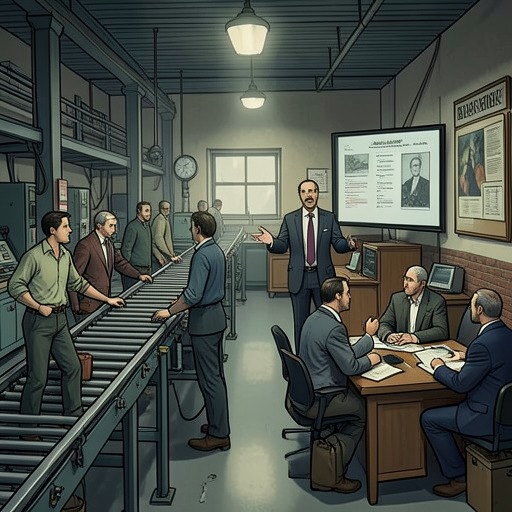
A company may appear to have an easy answer to coordination: executives can tell people what to do. That approach works better in a factory or corporate headquarters than in everyday life, but trying to run an entire company through command and control is, in the book’s account, futile. It takes too much time, demands information executives should not have to manage, and drains initiative from both workers and managers. Coordination that emerges without being dictated from above can make a company lighter and more flexible; concentrated power and excessive management layers obstruct that possibility.
The comparison between Ford and Toyota makes the cost of layers concrete. More than fifteen levels of managers separated Ford’s chairman from a factory-floor supervisor, while Toyota had only five. The contrast is not merely about organizational charts. When many intermediaries stand between people who do the work and those who make decisions, information must travel through a chain of authority, and the organization’s ability to respond depends on each link passing it along.
The book illustrates the distance between managerial oversight and working knowledge through an account of a General Motors plant in Van Nuys, California. Two assembly-line workers repeatedly failed to install a bracket that held a car’s sunshade. If it was missed, repair workers had to tear out the carpet at the end of the line and weld the bracket into place. When a supervisor showed the workers the costly repair, one was astonished to learn that the bracket held the sunshade: she had been doing the job for two years without being told what part she was welding. The failure was not simply individual carelessness. Workers had been assigned a task without information that would help them understand its purpose or consequences.
How hierarchy blocks information and responsibility
The problem extends beyond the factory floor. A rigid, multilayered corporation discourages information from moving freely because every boss can become a bottleneck or a potential adversary. A chart reprinted in the 1982 book In Search of Excellence showed how many bureaucratic routes a new-product proposal in one unnamed company had to travel before approval: 223. With so many layers between executives and employees in the field, senior leaders could not be sure that their picture of the company matched reality.
Hierarchy can also weaken the sense of responsibility that coordination is supposed to serve. The book describes American firms in the late 1960s and early 1970s where apparent democratization meant endless discussion, not a genuine distribution of decision-making power. Managers could sign off on subordinates’ advice and pass it upward, while subordinates assumed their bosses would check the information. Because authority was delegated only in appearance, people lower in the organization had little reason to take initiative. More discussion, by itself, did not mean that more people had meaningful influence over a decision.
The incentives surrounding advancement reinforced that silence. A 1962 study found that young executives who were more anxious about moving up communicated problem-related information less accurately. Another study of fifty-two middle managers associated upward mobility with withholding news of things that had gone wrong. In such an organization, the person who reports a fight, a budget problem, or another failure may risk becoming the messenger whom a superior would rather not hear. A chain of command can therefore transmit orders downward while discouraging unflattering information from traveling upward.
That distortion can become deliberate when rewards depend on meeting targets. Sociologist Donald Roy’s experience as a lathe operator in a machine shop showed the mechanism at work in a piece-rate system: once workers crossed production thresholds their pay increased, but if they worked too fast, the company could raise the thresholds. Workers therefore restricted their output and tried to manage the piece rate rather than simply maximize production. The book connects this dynamic to corporate budgets and performance goals. Managers who receive bonuses for hitting targets have reason to set easy targets by understating prospects, then to protect this year’s results even at future cost. A system that claims to direct effort toward performance can instead reward the manipulation of information on which decisions depend.
Centralized authority versus local knowledge
Command-and-control management rests on the assumption that problems and solutions should travel up and down the hierarchy. The book argues instead that decisions about local problems should, as far as possible, be made by people close to them. Drawing on Friedrich Hayek’s account of tacit knowledge, it emphasizes that experience-specific knowledge is difficult to summarize and transmit, yet can be crucial to finding a workable solution. In organizations as in markets, specialization and local knowledge may be more valuable in a particular decision than managerial expertise at a distance.
This is not a claim that decentralization solves every organizational problem. Its strength is that it encourages independence and specialization while allowing people to coordinate and address difficult tasks. Its weakness is that knowledge discovered in one part of a system may never reach the others. The organizational challenge is therefore to preserve the specificity of local knowledge while making it available for collective use—not to replace top-down control with disconnected pockets of expertise.
The distinction also clarifies why information-sharing alone is insufficient. In its discussion of the United States intelligence community before September 11, the book notes that agencies had specialized knowledge but lacked a means of aggregating judgments. Establishing a single central intelligence agency might make one organization responsible for the information, but would risk losing the diversity, independence, and local knowledge that separate agencies supplied. The problem was not decentralization by itself; it was decentralization without aggregation. Applied to companies, the same distinction means that eliminating layers is not enough: an organization must connect knowledge without requiring every decision to be made at the center.
A different design for organizational decisions
A better organizational design begins by placing decisions near the problems they concern and widening genuine employee involvement. The book notes that such involvement remains unusual: fewer than 2 percent of American companies, according to Blasi and Kruse, made real use of what they called high-performance work systems. Yet a study of successful companies by Nitin Nohria, William Joyce, and Bruce Roberson found that employees and managers were empowered to make many more independent decisions and encouraged to find ways to improve operations, including their own work.
The case for local authority is both informational and practical. People who are responsible for their working environments can be more engaged, and experimental results suggest that even the knowledge that one can act may matter. In a study involving puzzles and proofreading amid loud, random noise, one group had a button that could turn the sound off; the other did not. The group with the button solved five times as many puzzles and made fewer proofreading errors, even though no one pressed it. The finding supports a contrast with command and control: empowerment need not mean constant intervention. Having a real capacity to respond can itself change how people work.
The book’s broader prescription is thus neither rule by executives nor decision-making without structure. Managers can coordinate by ensuring that information and judgments move across the organization, while leaving room for people with relevant local knowledge to act independently. The key distinction is between authority that dictates every step and organizational arrangements that make knowledge, responsibility, and coordination compatible. Command-and-control management falters because it asks the center to know too much and leaves others too little reason to contribute what they know.